

PROMOTION - Urine Test for Cotinine/Nicotine (COT)
Original price was: 2,30 €.1,82 €Current price is: 1,82 €.
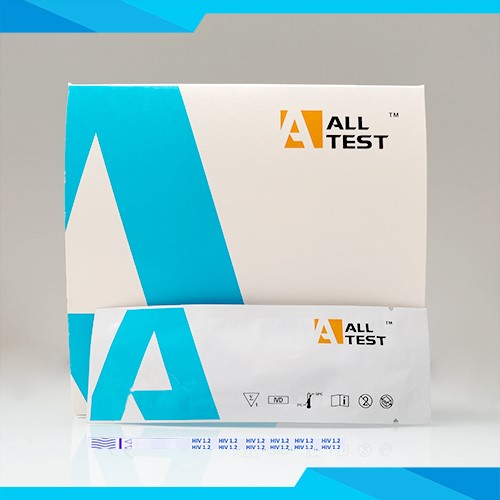
Rapid Blood Test for AIDS (HIV 1, 2), cassette
Price range: 8,80 € through 150,00 €
Rapid Blood Test for AIDS (HIV 1, 2), Strip
Price range: 7,80 € through 50,40 €
easy-to-use blood test for detecting antibodies against HIV types 1 and 2. Designed for at-home self-testing, it ensures privacy and reliable results.
✔ Fast results – in just 10 minutes
✔ High accuracy—with 2 tests per kit ensuring greater reliability for at-home testing
✔ Easy to use – a complete kit with everything you need for self-testing at home
🔹 Order now and get tested quickly, discreetly, and safely at home!
Description
HIV 1.2 Rapid Test – For Home Diagnosis
Description
The HIV 1.2 Rapid Test is designed for easy, discreet, and reliable home testing for the presence of antibodies to the AIDS virus (HIV 1.2).
Advantages:
✔ Easy to use – testing in just a few steps
✔ Fast results – within 5–10 minutes
✔ Discretion and convenience – test at home
✔ High sensitivity for antibody detection
✔ Kit with 2 tests – double testing ensures higher result reliability
What is HIV?
The human immunodeficiency virus (HIV) is a virus that attacks the immune system and can lead to AIDS (Acquired Immunodeficiency Syndrome) if left untreated. HIV is transmitted primarily through:
✔ Unprotected sexual contact
✔ Sharing needles or syringes
✔ From an infected mother to her baby during pregnancy, childbirth, or breastfeeding
🛑 Important: HIV is not transmitted through kissing, hugging, sharing utensils, or casual contact.
🛑 Important: The test does not detect the infection immediately after exposure. Antibodies against the HIV virus reach levels detectable by immunological tests no earlier than 3 weeks after exposure. The most reliable test result is obtained at least 3 months after a potentially risky exposure.
Why is it important to get tested?
🩺 Early detection of HIV is vital for starting treatment, which can help people with the virus lead long and healthy lives.
🛡 Regular testing is recommended for anyone who has been at risk, even if they have no symptoms.
🔹 LIMITATIONS OF THE METHOD
⚠ The HIV 1.2 rapid test is used only to detect HIV antibodies in blood samples. This means that the body has been exposed to the virus and has responded by producing antibodies, or that the person is a so-called seropositive carrier of the virus. If you receive a repeat positive result, have a confirmatory test performed at the National Reference Laboratory for HIV/AIDS.
⚠ It does not determine the quantity or rate of antibody production.
⚠ Results must be interpreted in conjunction with other clinical information. An AIDS diagnosis is made by a clinician based on the definition and clinical classification adopted by the Centers for Disease Control and Prevention.
⚠ Despite advances in biotechnology and the accuracy of diagnostic tests, there is a false-positive rate of approximately 0.1%. Such results most commonly occur in patients with or who have had malaria, systemic autoimmune diseases, or individuals with hypergammaglobulinemia.
⚠ A negative result does not rule out the possibility of HIV infection entirely.
⚠ If symptoms are present, further laboratory testing is recommended.
🔹 TESTING PROCEDURE
✅ Preparation
🟢 Allow the test and buffer to reach room temperature (15–30°C).
🟢 Remove the test cassette from the package and use it as soon as possible.
🟢 Make sure the test and control lines are not colored before you begin.
🟢 Place the cassette on a clean, flat surface.
🔹 How to collect a sample? (Finger prick test)
1️⃣ Wash your hands thoroughly and disinfect the selected finger with the included wipe.
2️⃣ Massage the finger to improve blood flow.
3️⃣ Prick the finger with the lancet and let the first drop of blood drip off.
4️⃣ Draw the sample with the capillary pipette to about 2 cm.
5️⃣ Transfer the entire contents into the sample well of the test cassette.
📌 Alternative method: Once a drop of blood has formed, place it directly into the test well.
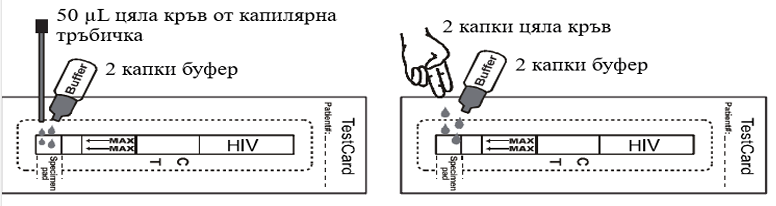
🔹 STARTING THE TEST
The test must be started immediately after adding the blood sample.
✔ Add 2 drops of buffer solution to the sample well (S).
✔ Wait 5 minutes before interpreting the results.
⏳ The result must be read within 3–10 minutes!
❌ Do not interpret the result after more than 10 minutes.
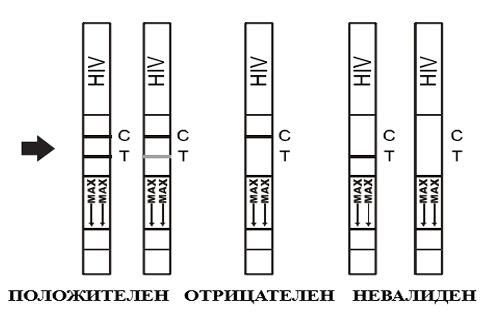
🔹 INTERPRETING THE RESULTS
✅ Positive
✔ Two lines: one in the control zone (C) and one in the test zone (T).
✔ Even the faintest line in the test zone (T) indicates a positive result.
✔ Recommendation: Retest after a few hours. If you receive another positive result, consult an infectious disease specialist. At their discretion, a confirmatory test using a different method may be performed at the National HIV Reference Laboratory (NRL) at the National Center for Infectious and Parasitic Diseases (NCIPD), Sofia, 26 Yanko Sakazov Blvd.
❌ Negative
✔ Only one line in the control zone (C); no line in the test zone (T).
✔ No antibodies detected or below the test’s detection limit.
⚠ Invalid
✔ No line in the control zone (C).
✔ Causes: insufficient sample volume, improper storage, or incorrect procedure.
✔ Solution: Repeat the test with a new cassette.
Additional Information
- Regular testing is key to prevention. If you are in a high-risk group, it is recommended that you get tested every 3 to 6 months.
- HIV treatment (antiretroviral therapy) allows people with the virus to lead a full life and prevents the transmission of HIV to others.
- When should the test be used?
This test detects HIV infection if used 3 months after a risk event. If you want to be tested before 3 months have passed, you should see your doctor or a local healthcare provider.
If you have HIV, it will show up on the HIV self-test kit if at least three months have passed since you were exposed. This three-month period, during which HIV may be present but not detected, is also called the incubation period (window period).
🔹 CONTENTS
📦 The kit includes:
✔ 2 test strips
✔ 2 automatic lancets
✔ 2 disinfectant wipes
✔ 2 test tubes with buffer solution
✔ 2 capillary pipettes
Original instructions for use and complete technical specifications.
Additional information
| Weight | 0,1 kg |
|---|
Reviews (0)
Only logged in customers who have purchased this product may leave a review.


Reviews
There are no reviews yet.